How Public Transit affects Public Health
Motivation
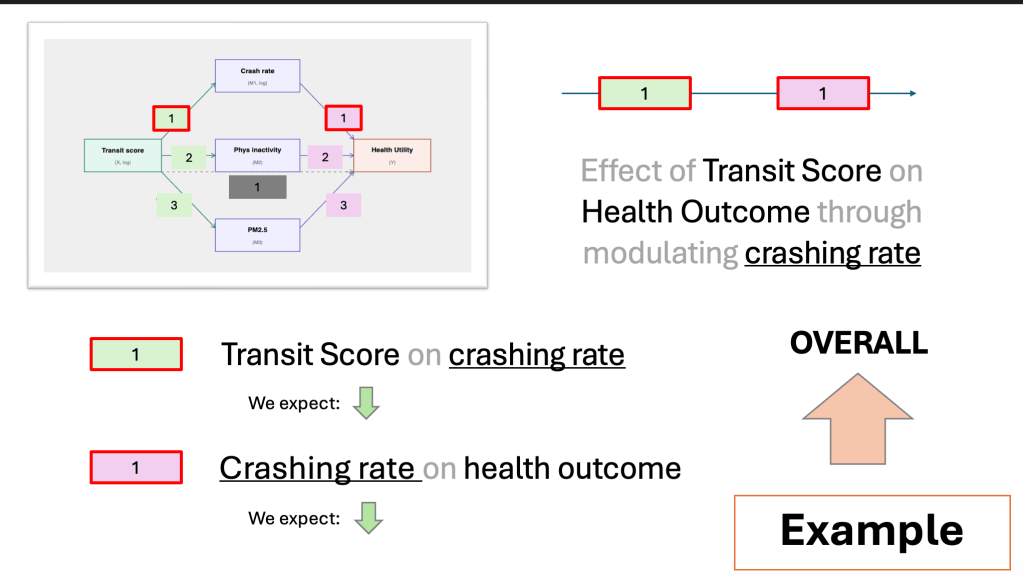
It is generally accepted that better public transit is associated with better public health, however, what serves as the mediator that relays such impact remain unmeasured. Litman (2010) proposed a model that listed reducing crash rate, improving air quality, and increasing physical activities as three of the elements to this change; in this study, we aim to verify this claim via constructing a model.
Methods
A mediation model that allows interaction is constructed, exposure is defined as jobs accessible via transit in a given time, outcome is built from health utility model (multiplicative) from various data source for input and coefficients, and mediator values acquired mostly from public sources, but some provided generously from the MassDOT.
Result Highlight
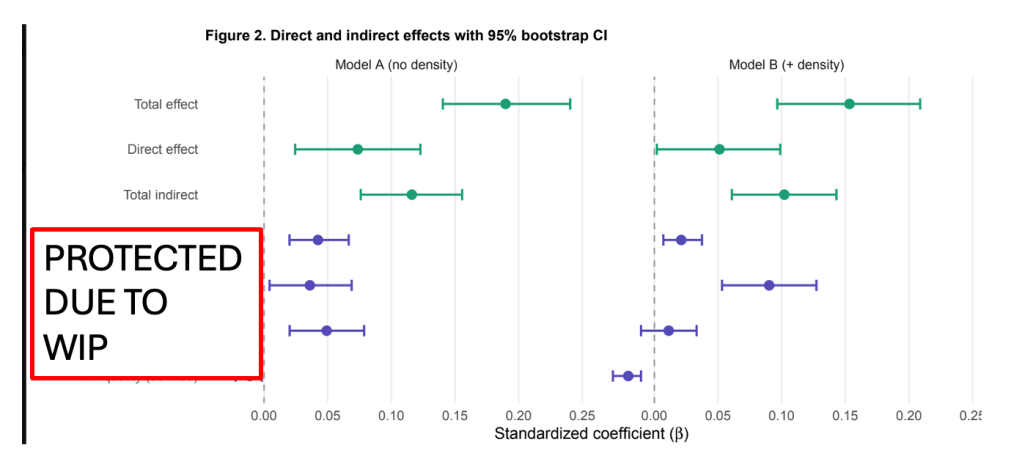
- We have verified the general positive association between public transit and public health.
- Some mediators (different versions of air quality index), due to spatial correlation, may not exhibit clear association.
- There is indeed a clear effect via increase in non-leisure physical activity and crash rate reduction towards improvement of public health.
Future Direction
The model is constructed to be interpreted at association level; additionally, spatial correlation cannot be eliminated. Health utility was constructed with emphasize to chronic conditions, hence, acute injuries from traffic accident that did not cause injury that can be captured via the model may be underestimated. A new model specification may be considered to deal with the two issues above.
In Print
This article is in final manuscript drafting as of OCT 2026. Preprint will become available once completed.

