GPC-M: Statistical method for cross-trait genetic association study

Motivation
When studying a SNP’s influence on two traits, the easiest method is to find their respective coefficients (alpha1 and beta 1, fig A), via doing 2 GWASs. However, if two traits are causally related (fig B), then the coefficients found would become inaccurate. In fact, assuming a causal direction from A to B (beta 2), the model becomes a single-mediator model (fig C).
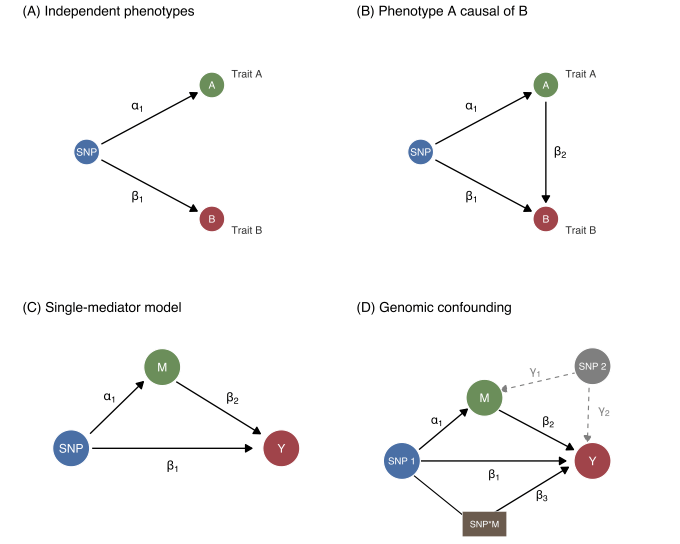
While existing causal mediation analytic tools (such as those proposed by VanderWeele et al.) can come in handy, other genes in the genome-wide search who also happens to affect both M and Y (previously A and B) creates a spurious confounding link, and pollutes the trait-trait coefficients, as shown in fig D. To the best of our knowledge, there is no method specifically adjusts to these two problems simultaneously.
GPC-M is a joint-cross-association quantifying method that accounts for both causal structure within traits and genomic confounding. It produces HPI, a test statistics, that can quantify the “strength” of how one SNP is “jointly associated with two traits”, with directional information (i.e HPI < 0 means negative effect).
GPCM is…
- a decomposition method that returns clear coefficient of each pathway
- a method that provides index to quantify how a gene is “associated with the two traits at the same time”
GPCM is not…
- a MR method
Result Highlight
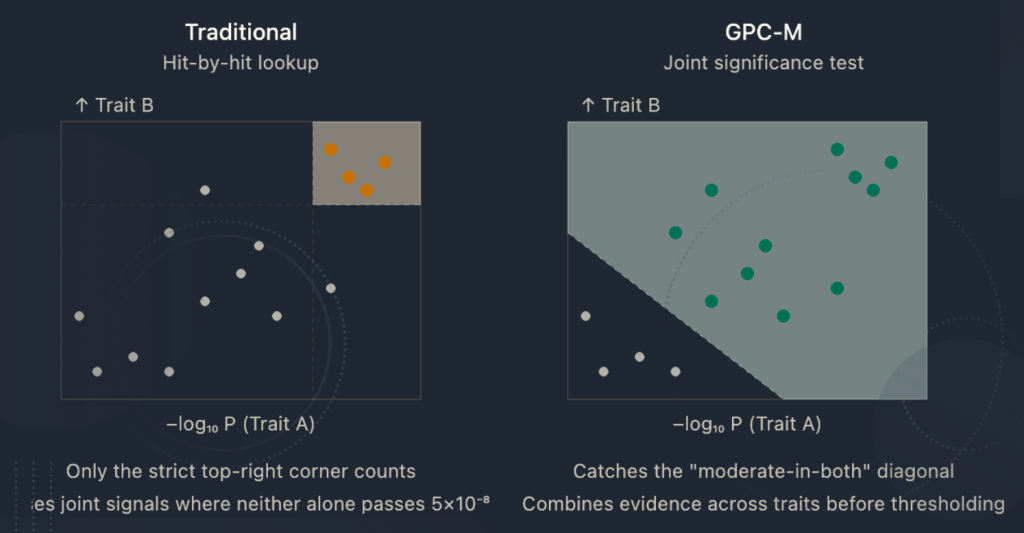
- GPC-M provides coefficients that correctly accounts for the causal structure between traits and genomic confounding. People often take SNPs that are significant in both GWASes, this means the power is greatly compromised because the gate has to be passed twice; even if power reduction is overlooked, the model specification is incorrect. By doing one joint-association test via GPC-M, the power is increased without a lapse in accuracy.
- GPC-M discovers new variants that was previously not known to associate with both traits, or only with one-arm. rs112178027 is not marginally significant for either trait of Diabetes and Hyperlipidemia; however, molecular evidence from RegulomeDB showed that it has an evidence grade of 1B to be functional.
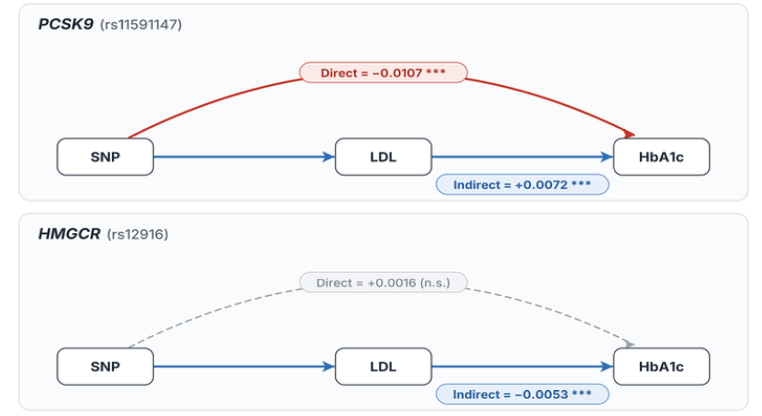
- GPC-M can provide heuristic evidence to drug-development prioritization. For example, statin is known to reduce LDL level, but is associated with diabetes. GPC-M shows that while both HMGCR and PCSK9 alters HbA1c and LDL level within a similar ratio, one of them are mostly driving HbA1c directly while another primarily relays the secondary effect via altering LDL. When attempting to mitigate side effect, GPC-M may inform where the path lies.
Future Direction
GPC-M is a method currently requiring pre-specified causal direction, and it cannot deal with time-varying structure. We will make effort to extend to these two territories in the immediate follow up.
In Print
This article is under peer review as of OCT 2026. Preprint will become available shortly.
This article was also partially presented as a poster at the ASHG 2026 (Montreal)!