Physmerge: A distance-based LD Signal Picking Tool
Motivation
Convention for doing GWAS involves LD pruning/clumping. By using the LD panel, scientist determine whether two significant variants may be in linkage. However, such data (LD ref panel) may not always be available, additionally, quality of LD reference information depends on the ancestral composition of the panel data.
Methods
In physmerge, we implement a well-known alternative to LD-based methods: distance-based clumping. Significant variants within a given window are regarded as one, irrespective of the LD panel, in fact, panel data is not required at all.
To quantify the improvement scored via this implementation, we discuss 1) how different ancestry contamination degrades the efficacy of LD-based method, 2) what is the best choice for window size across different racial group, and 3) H2H comparison between distance-based and LD-panel based method. Distance-based method achieve satisfactory or non-inferior status in our benchmark tests, while requiring a lot less exclusive resources.
Result Highlight
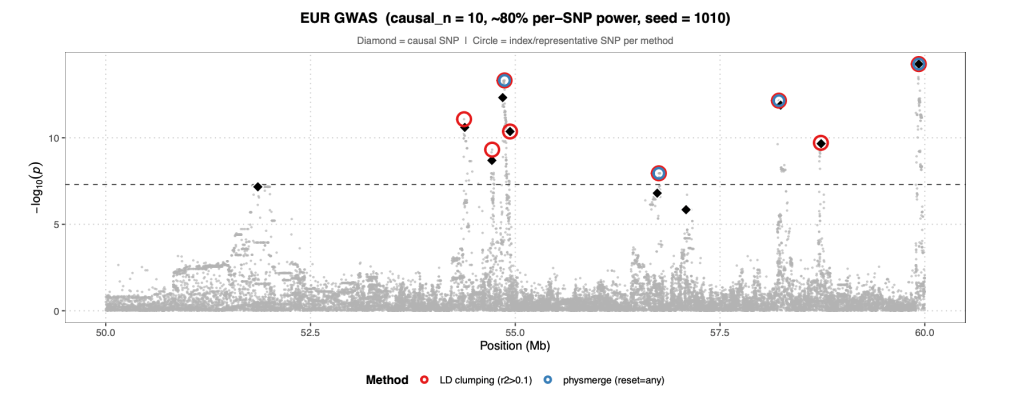
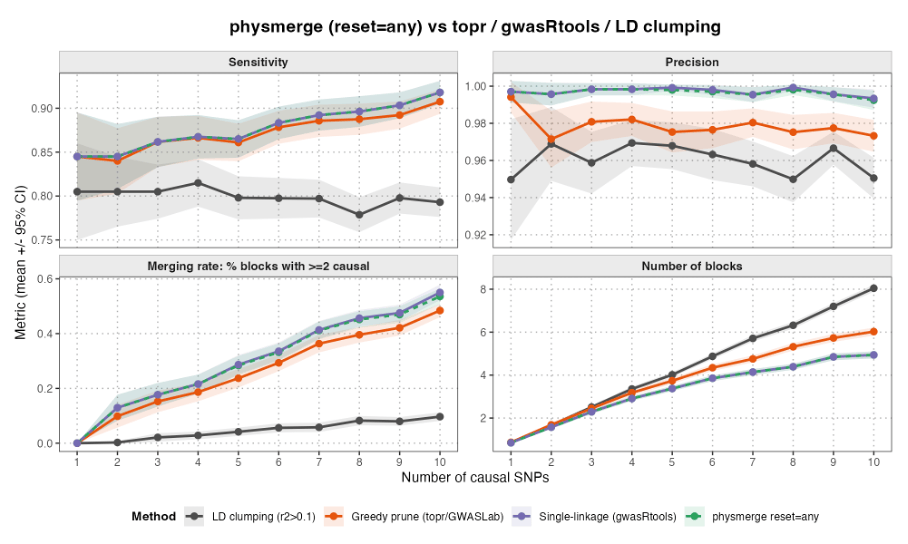
In our simulation, we have proved that physmerge achieved non-inferior status in typical scenarios, with the drawbacks being higher block-merging rate (given that there is no likelihood to separate true signals that are <1 window apart).
We have also proven that despite different median length of LD influence in different ancestry, there is no need to routinely pick different window length as performance is barely affected.
Finally, we have proven that cross-ancestry contamination to the LD reference panel further disadvantages LD-based methods against physmerge, though this is largely non-apparent within same continent, even among Finnish population, one of the most isolated European ethnic group.
A fast-processing C executable, SAS and R implementations are available at this github link and a paper formally detailing the implementation is currently underway.
Future Direction
We are expanding Physmerge into a family of methods that has different probability of extending a window depending on different circumstances, and whether this interacts with different parameters of testing. Stay tuned for more!
In Print
As this article is still in final stage of development, we cannot share all details of it. This section will be updated once the preprint is out.

